
How a $14M Multi-Location Venue Went From Survival Mode to Board-Ready in Months
Helped a multi-location venue build the financial infrastructure and left them with a board system, a cash model and a leadership team that finally clicked.
- Home
- Case Studies
- How a $14M Multi-Location Venue Went From Survival Mode to Board-Ready in Months
The Situation
WhirlyBall was generating $14M to $15M across multiple locations but sales had dropped year-over-year, cash was tight, and the leadership team had no structure for making decisions or tracking what was ahead. They were negotiating leases with percentage-rent clauses, exploring refinancing options, and managing landlord and lender conversations without a financial narrative to support any of it.
Key Situation Factors
The Challenge
The leadership team was capable but there was no system keeping everyone accountable. No defined close cadence meant the numbers were always a little behind. No structured board process meant decisions got made in hallways instead of meetings. And when lenders or landlords asked hard questions, the answers were coming from memory instead of documented financials.
Good operators were working harder than they needed to because the infrastructure around them was not keeping up.
- No defined month-end close timeline or ownership
- KPIs tracked inconsistently across sales, marketing and finance
- Liquidity decisions made without modeling the operational tradeoffs
- No accountability structure between leadership meetings
- Lender and landlord conversations not backed by documented assumptions
- Unit economics and labor costs never formally pressure-tested
Our Approach
Three phases. Each one building on the last from getting the board functional, to making finance a leadership tool, to pointing everything toward growth.
Step 1
Locked meeting dates upfront, set a pre-read process one week before every meeting, and defined who owned what across the CEO, CFO, and board chair. Meetings had agendas, minutes, and action-item tracking so nothing fell through the cracks between sessions.
Step 2
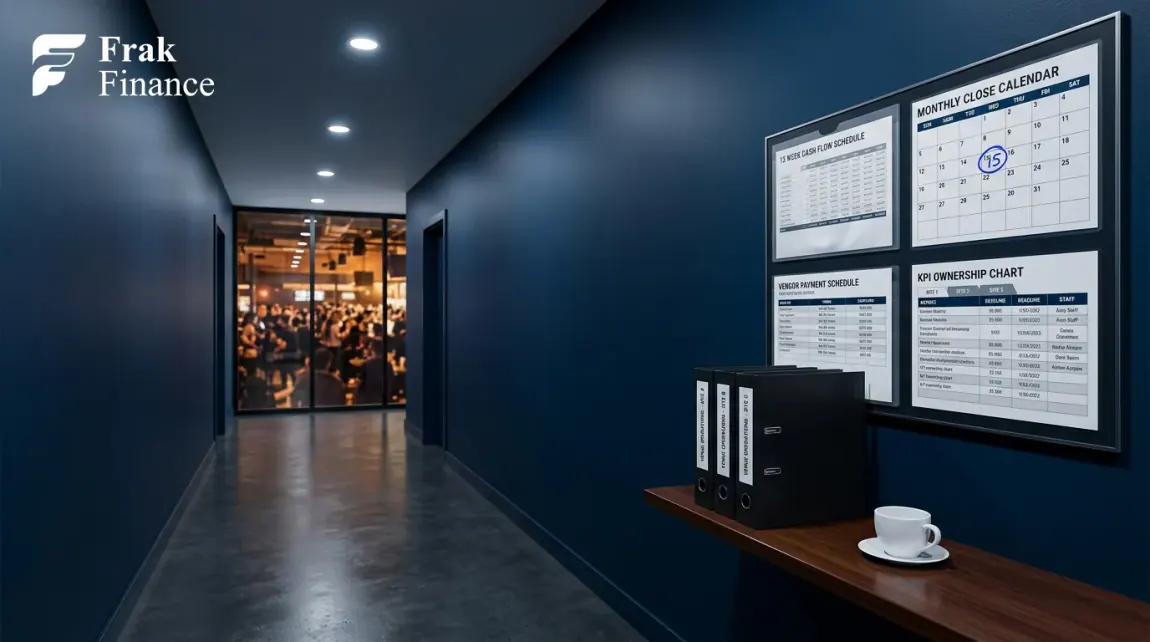
Set a weekly leadership meeting rhythm, defined the month-end close window with a hard target of the 15th and no later than the 21st, and built KPI dashboards with named owners across sales, marketing, and finance.
Step 3
Modeled weekly inflow targets against operating outflows of roughly $197K per week excluding rent and $250K including rent. Rent scenarios, funding needs, and runway were visible in one place and updated on a consistent basis.
Step 4
Pressure-tested unit-level labor costs, revenue targets, and cash break-even assumptions at the location level. Set the FY2026 budget deadline at January 31 with year-end financials due February 15 and assigned clear ownership across the leadership team.
The pre-reads started landing a week before every meeting. Leadership walked in already aligned on cash, open items, and priorities. Decisions got made in the room instead of after it. The 13-week model gave everyone a shared view of runway, rent scenarios, and funding options. Executives stopped getting pulled into daily cash checks and started operating from a plan with clear owners on every key metric.
Quantitative Results
Weekly operating costs mapped out in a 13-week cash flow model so leadership always knew where the runway stood.
Leadership finally had a forward-looking view of inflows, outflows, and rent scenarios in one place.
Structured and advanced lender conversations around a credit facility while evaluating alternative funding options.
Qualitative Results
The CEO stopped spending time on cash monitoring and started spending it on the business. Decisions that used to drag got made in the room. Landlords and lenders got consistent, documented answers instead of estimates. The whole leadership team was finally working from the same plan.
- Board meetings ran on pre-reads with documented action items
- KPI ownership assigned across sales, marketing, and finance
- Lender and landlord conversations anchored to consistent reporting
- Escalation paths defined so nothing fell between meetings
- Close cadence established with named owners and hard deadlines
- CEO confidence in decisions improved with structured team support
Key Takeaways
Revenue was there. The board cadence, close deadline, and cash model were not.
A 13-week cash view made landlord and lender conversations straightforward.
The team was capable. What was missing was named ownership on every KPI.
Pre-reads and a board cadence gave the CEO confidence to focus on the business.
Location-Based Entertainment & Hospitality
~$14M–$15M Annual Revenue
Ongoing Engagement
Stabilize, Realign, Reset for Growth
Similar Cases We Have Resolved
How a $14M Multi-Location Venue Went From Survival Mode to Board-Ready in Months
Accounting Cleanup & SOP Implementation for Scaling Medical Device Distributor

Consulting Firm Cuts Cash Flow Gaps in Half With KPIs

A $2M Tech Startup Finally Got Control of Its Finances

An E-Commerce Company Added $1.2M to Their Sale Price in 18 Months

Seasonal Retailer Escapes the Off-Season Cash Trap

How a SaaS Company Survived Failed Diligence
Ready to See Results Like These for Your Business?
Talk to our team and find out where the gaps are and what Frak Finance can do for your bottom line.