
How a SaaS Company Survived Failed Diligence
How clean financials and a rebuilt QoE kept a SaaS deal alive at full value.
- Home
- Case Studies
- How a SaaS Company Survived Failed Diligence
The Situation
When the buyer ran their QoE, the books didn’t hold up. Recurring and one-time revenue were mixed together, EBITDA adjustments had no documentation, and the deal stalled almost immediately.
Key Situation Factors
The Challenge
The numbers were not the only problem. The bigger issue was what they were doing to buyer confidence. Undefendable ARR and undocumented adjustments shift every conversation from growth potential to risk. That is when deals get repriced or fall apart entirely.
- Buyer could not underwrite the ARR with confidence
- Every margin figure became a question mark
- No documentation meant no way to verify anything
- Financial picture felt like a liability not an asset
- Deal trust was eroding fast
Our Approach
The deal was live and the clock was running. We had to rebuild the financial picture from the ground up, revenue, expenses, and documentation, fast enough to keep the buyer at the table.
Step 1
Locked meeting dates upfront, set a pre-read process one week before every meeting, and defined who owned what across the CEO, CFO, and board chair. Meetings had agendas, minutes, and action-item tracking so nothing fell through the cracks between sessions.
Step 2
Set a weekly leadership meeting rhythm, defined the month-end close window with a hard target of the 15th and no later than the 21st, and built KPI dashboards with named owners across sales, marketing, and finance.
Step 3
Modeled weekly inflow targets against operating outflows of roughly $197K per week excluding rent and $250K including rent. Rent scenarios, funding needs, and runway were visible in one place and updated on a consistent basis.
Step 4
Pressure-tested unit-level labor costs, revenue targets, and cash break-even assumptions at the location level. Set the FY2026 budget deadline at January 31 with year-end financials due February 15 and assigned clear ownership across the leadership team.
Phase 1
We went back to the contract level and separated recurring subscription revenue from one-time fees and custom dev work. From there we rebuilt the ARR schedule from scratch and reconciled all deferred revenue balances. The result was a clean, defensible $750K ARR that buyers could actually underwrite.
Phase 2
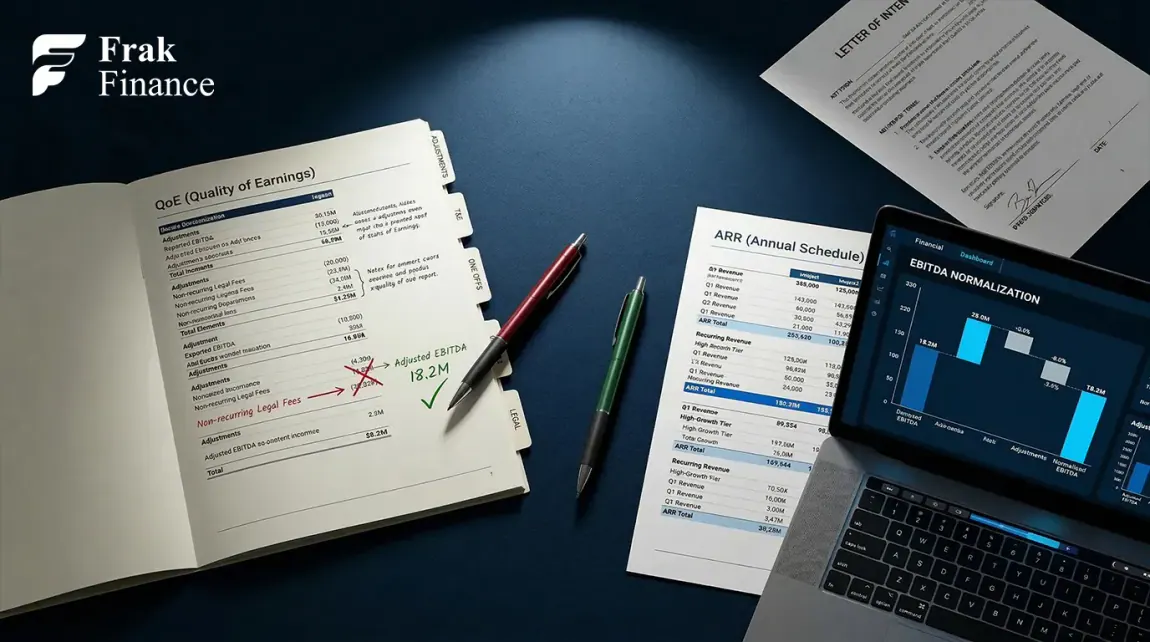
We pulled out every non-operating cost buried inside the operating structure, including owner expenses, one-time legal fees, and non-recurring contractor costs. Then we built a normalized EBITDA bridge with a monthly recurring margin breakdown. True operating profitability was no longer a question mark.
Phase 3
We prepared a formal QoE style report with a full adjustment schedule, every entry tied back to source documentation. On top of that we delivered buyer-ready revenue and churn analytics. Nothing was left without a paper trail.
Once the revised QoE package was in the buyer’s hands, the dynamic changed quickly. Follow-up questions dropped off, diligence started moving again, and the discussion shifted from “what are the risks here” to “how do we grow this.” The valuation conversation stabilized right back around the original LOI terms. Financial credibility, once rebuilt, did exactly what it was supposed to do.
QUANTITATIVE RESULTS
Recurring revenue separated, rebuilt from contract level, and confirmed as a clean ARR figure buyers could confidently underwrite.
The original 6x revenue multiple held all the way through close. Buyer stayed at agreed terms, no renegotiation.
The deal that was close to collapsing closed at full value with no reduction to the agreed terms.
Every single EBITDA adjustment documented and tied back to source. Nothing left open for a buyer to challenge.
Qualitative Results
Getting the financials right did more than keep the deal alive. It changed the entire dynamic with the buyer. Questions slowed down, diligence stopped feeling like an interrogation, and the founder walked into final negotiations actually feeling in control.
- Buyer trust in the numbers went up significantly
- The business no longer looked like an accounting risk
- Diligence became faster and far less back and forth
- Management finally had clarity on their own ARR
- A reporting standard now in place for the next investor conversation
Key Takeaways
Mixing recurring and one-time revenue does not just confuse buyers, it puts your entire valuation at risk.
Undocumented EBITDA adjustments are not a minor oversight in diligence. They are a deal killer.
The $4.5M was always there. The business was worth it. The financials just were not saying so.
A rebuilt QoE package brought buyers back to the table without renegotiating the multiple.
B2B Software (SaaS)
~$750K in recurring annual revenue
Pre-close, active deal under LOI
Pre-Exit
Similar Cases We Have Resolved
How a $14M Multi-Location Venue Went From Survival Mode to Board-Ready in Months

Consulting Firm Cuts Cash Flow Gaps in Half With KPIs
Accounting Cleanup & SOP Implementation for Scaling Medical Device Distributor

A $2M Tech Startup Finally Got Control of Its Finances
Consulting Firm Cuts Cash Flow Gaps in Half With KPIs

An E-Commerce Company Added $1.2M to Their Sale Price in 18 Months
A $2M Tech Startup Finally Got Control of Its Finances

Seasonal Retailer Escapes the Off-Season Cash Trap
An E-Commerce Company Added $1.2M to Their Sale Price in 18 Months

How a SaaS Company Survived Failed Diligence
Seasonal Retailer Escapes the Off-Season Cash Trap
Selling Your Business and Need the Financials to Hold Up?
Schedule a conversation about getting your financial package buyer-ready before diligence begins.