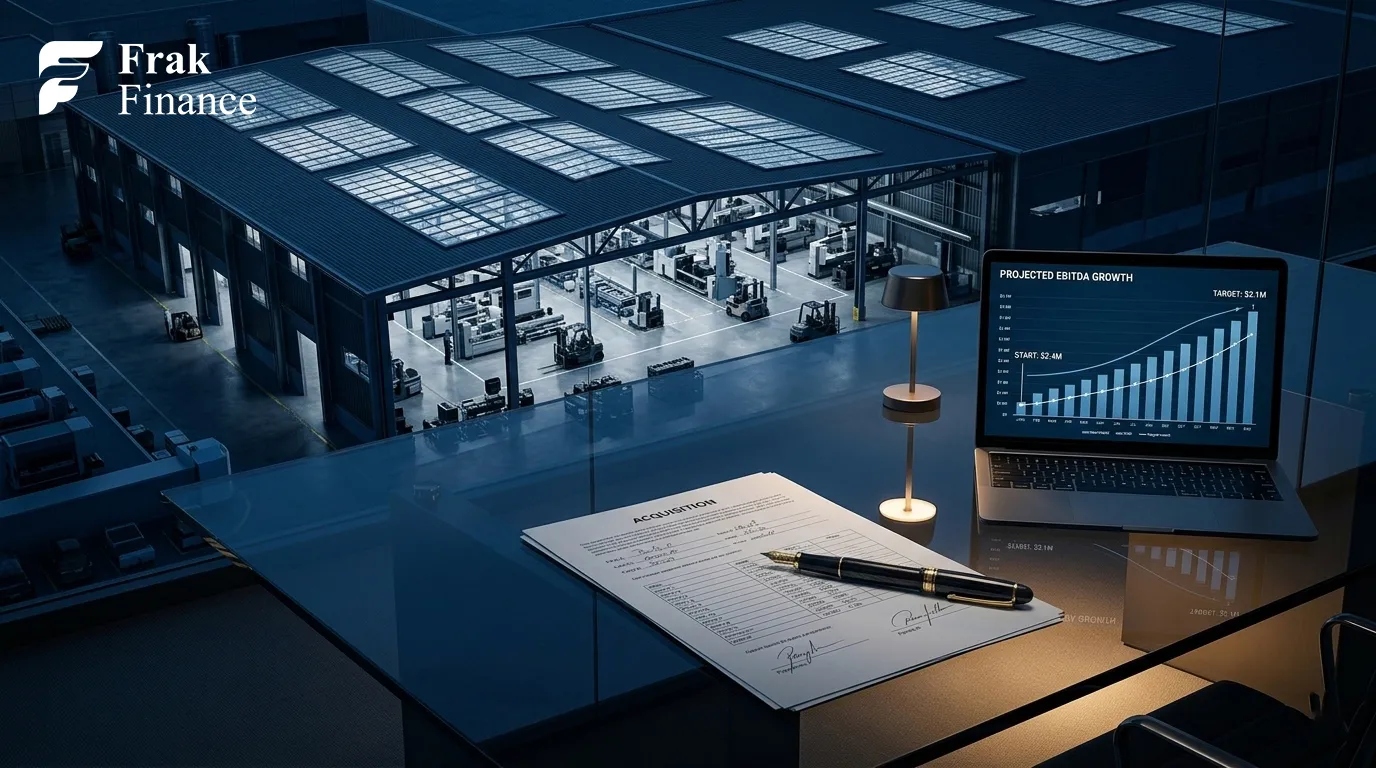
A founder-dependent manufacturer got exit-ready and closed at a valuation 20% above early estimates.
The owners had built a legitimate $18M manufacturing business over two generations. With retirement three years away, they came to Frak Finance knowing they wanted to exit but without a clear plan for how to get there or what the business was really worth to a buyer.
The books were messy, the revenue was fragile, and the business only worked because the owners made it work. There was no defensible EBITDA baseline, no contract structure that gave a buyer confidence in future revenue, and no proof the business could survive a ownership transition. To a buyer, that combination doesn’t just lower the multiple. It raises serious questions about whether the deal is worth doing at all.
There was no single fix here. We worked through four connected problems in the right order.
Step 1
Locked meeting dates upfront, set a pre-read process one week before every meeting, and defined who owned what across the CEO, CFO, and board chair. Meetings had agendas, minutes, and action-item tracking so nothing fell through the cracks between sessions.
Step 2
Set a weekly leadership meeting rhythm, defined the month-end close window with a hard target of the 15th and no later than the 21st, and built KPI dashboards with named owners across sales, marketing, and finance.
Step 3
Modeled weekly inflow targets against operating outflows of roughly $197K per week excluding rent and $250K including rent. Rent scenarios, funding needs, and runway were visible in one place and updated on a consistent basis.
Step 4
Pressure-tested unit-level labor costs, revenue targets, and cash break-even assumptions at the location level. Set the FY2026 budget deadline at January 31 with year-end financials due February 15 and assigned clear ownership across the leadership team.
Step 1
Three years of financials got standardized, EBITDA got normalized by removing owner-related and personal expenses, and we set up monthly reporting with margin tracking by product line.
Step 2
We went after a 30% EBITDA improvement through vendor renegotiations, cutting operational waste, repricing undervalued SKUs, and pointing the sales focus toward higher-margin and recurring revenue.
Step 3
We built a plan to bring new mid-tier customers in, locked existing ones into multi-year contracts, and set up proper pipeline tracking to reduce that 50% single-customer dependency.
Step 4
We documented SOPs across production, procurement, and sales, promoted an operations manager into a leadership role, and handed off key customer relationships to the wider team.
By end of year two, EBITDA was up 28%, customer concentration had dropped to 35%, and the management team was running operations without the owners. Buyers stopped discounting the risk and started talking about growth. Multiple indications of interest came in above what early informal conversations had suggested.
Metric
Before
After
Growth
ROAS
2.1
4.3
+105%
Revenue Growth
—
+38% YoY
+38%
Customer Acquisition Cost
High
Reduced
-27%
Conversion Rate
1.8%
3.5%
+94%
Average Order Value
$78
$102
+31%
Clean financials and a management team that could operate independently changed how buyers approached the deal. Due diligence was straightforward, there were no last-minute price adjustments, and having multiple interested parties meant the owners weren’t negotiating from a weak position.
Unclean financials don't just slow down due diligence. They give buyers a reason to lower their offer
A 50% revenue dependency on one customer will show up in your multiple. Buyers price that risk in.
Owner dependency is a valuation discount. A business that needs its founders to function is harder to sell and cheaper to buy.
Exit planning done three years out turned a 4.2x informal estimate into a 5x close. The timing of when you start matters.
Industrial Manufacturing
~$18M annual revenue
3 years
Pre-Exit
Lorem ipsum dolor sit amet, consectetur adipiscing elit. Proin tincidunt tellus sed nisi accumsan vestibulum. In hac habitasse platea dictumst. Fusce ac lacinia quam. Phasellus…





The cash flow improved fast. But the bigger change was how the business started operating day to day.
Duis consequat libero ac tincidunt consectetur. Curabitur a magna sit amet orci mollis vehicula. Morbi at enim a ex mollis sodales ut eu elit. Quisque egestas.