Helped a multi-location venue build the financial infrastructure and left them with a board system, a cash model and a leadership team that finally clicked.
WhirlyBall was generating $14M to $15M across multiple locations but sales had dropped year-over-year, cash was tight, and the leadership team had no structure for making decisions or tracking what was ahead. They were negotiating leases with percentage-rent clauses, exploring refinancing options, and managing landlord and lender conversations without a financial narrative to support any of it.
The leadership team was capable but there was no system keeping everyone accountable. No defined close cadence meant the numbers were always a little behind. No structured board process meant decisions got made in hallways instead of meetings. And when lenders or landlords asked hard questions, the answers were coming from memory instead of documented financials.
Good operators were working harder than they needed to because the infrastructure around them was not keeping up.
Three phases. Each one building on the last from getting the board functional, to making finance a leadership tool, to pointing everything toward growth.
Step 1
Locked meeting dates upfront, set a pre-read process one week before every meeting, and defined who owned what across the CEO, CFO, and board chair. Meetings had agendas, minutes, and action-item tracking so nothing fell through the cracks between sessions.
Step 2
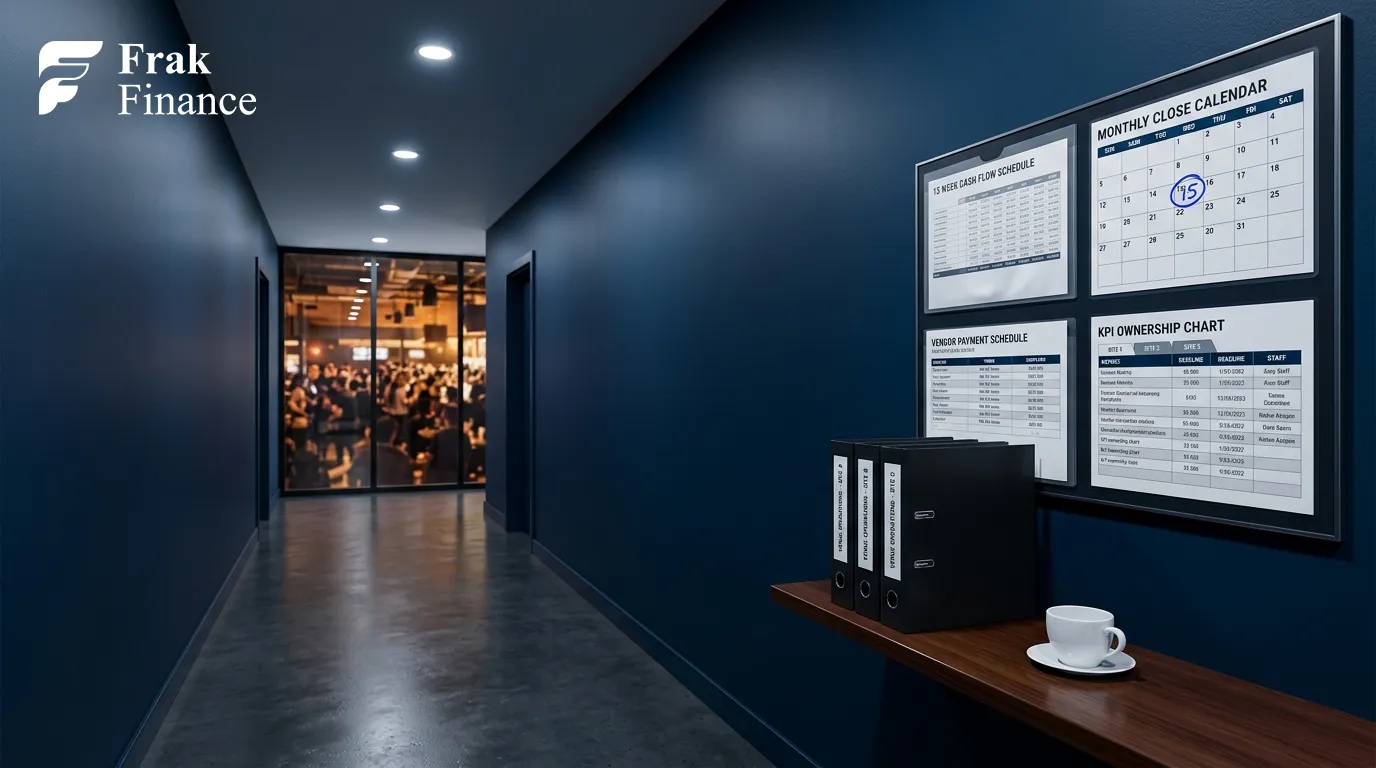
Set a weekly leadership meeting rhythm, defined the month-end close window with a hard target of the 15th and no later than the 21st, and built KPI dashboards with named owners across sales, marketing, and finance.
Step 3
Modeled weekly inflow targets against operating outflows of roughly $197K per week excluding rent and $250K including rent. Rent scenarios, funding needs, and runway were visible in one place and updated on a consistent basis.
Step 4
Pressure-tested unit-level labor costs, revenue targets, and cash break-even assumptions at the location level. Set the FY2026 budget deadline at January 31 with year-end financials due February 15 and assigned clear ownership across the leadership team.
Step 1
Locked meeting dates upfront, set a pre-read process one week before every meeting, and defined who owned what across the CEO, CFO, and board chair. Meetings had agendas, minutes, and action-item tracking so nothing fell through the cracks between sessions.
Step 2
Set a weekly leadership meeting rhythm, defined the month-end close window with a hard target of the 15th and no later than the 21st, and built KPI dashboards with named owners across sales, marketing, and finance.
Step 3
Modeled weekly inflow targets against operating outflows of roughly $197K per week excluding rent and $250K including rent. Rent scenarios, funding needs, and runway were visible in one place and updated on a consistent basis.
Step 4
Pressure-tested unit-level labor costs, revenue targets, and cash break-even assumptions at the location level. Set the FY2026 budget deadline at January 31 with year-end financials due February 15 and assigned clear ownership across the leadership team.
The pre-reads started landing a week before every meeting. Leadership walked in already aligned on cash, open items, and priorities. Decisions got made in the room instead of after it. The 13-week model gave everyone a shared view of runway, rent scenarios, and funding options. Executives stopped getting pulled into daily cash checks and started operating from a plan with clear owners on every key metric.
Of customers recently chose a financial product from a provider other than their main bank.
Of revenues at risk between now and 2025 if card-issuing banks are slow to invest in next-gen payment options.
The share of US banks’ working hours which could be impacted by technologies like generative AI.
The CEO stopped spending time on cash monitoring and started spending it on the business. Decisions that used to drag got made in the room. Landlords and lenders got consistent, documented answers instead of estimates. The whole leadership team was finally working from the same plan.
Revenue was there. The board cadence, close deadline, and cash model were not.
A 13-week cash view made landlord and lender conversations straightforward.
The team was capable. What was missing was named ownership on every KPI.
Pre-reads and a board cadence gave the CEO confidence to focus on the business.
Location-Based Entertainment & Hospitality
~$14M–$15M Annual Revenue
Ongoing Engagement
Stabilize, Realign, Reset for Growth
Lorem ipsum dolor sit amet, consectetur adipiscing elit. Proin tincidunt tellus sed nisi accumsan vestibulum. In hac habitasse platea dictumst. Fusce ac lacinia quam. Phasellus…





The cash flow improved fast. But the bigger change was how the business started operating day to day.
Duis consequat libero ac tincidunt consectetur. Curabitur a magna sit amet orci mollis vehicula. Morbi at enim a ex mollis sodales ut eu elit. Quisque egestas.