They were bringing in $2M a year but had no idea where it was going. We fixed that without them hiring a full-time CFO.
The startup was doing $2M a year and the revenue was trending up. From the outside, things looked like they were working. But the financial side of the business was reactive, disorganized, and not built for the stage they were entering.
Revenue was climbing but the financial foundation wasn’t keeping up. Every major decision, whether it was hiring, spending, or expanding, was being made without the numbers to back it up. The problem wasn’t the growth. It was that nobody had a clear picture of where the cash was going or what was coming next.
We came in and built the financial infrastructure this business was missing, then used it to get control of cash, spending, and planning all at once.
Step 1
Locked meeting dates upfront, set a pre-read process one week before every meeting, and defined who owned what across the CEO, CFO, and board chair. Meetings had agendas, minutes, and action-item tracking so nothing fell through the cracks between sessions.
Step 2
Set a weekly leadership meeting rhythm, defined the month-end close window with a hard target of the 15th and no later than the 21st, and built KPI dashboards with named owners across sales, marketing, and finance.
Step 3
Modeled weekly inflow targets against operating outflows of roughly $197K per week excluding rent and $250K including rent. Rent scenarios, funding needs, and runway were visible in one place and updated on a consistent basis.
Step 4
Pressure-tested unit-level labor costs, revenue targets, and cash break-even assumptions at the location level. Set the FY2026 budget deadline at January 31 with year-end financials due February 15 and assigned clear ownership across the leadership team.
Step 1
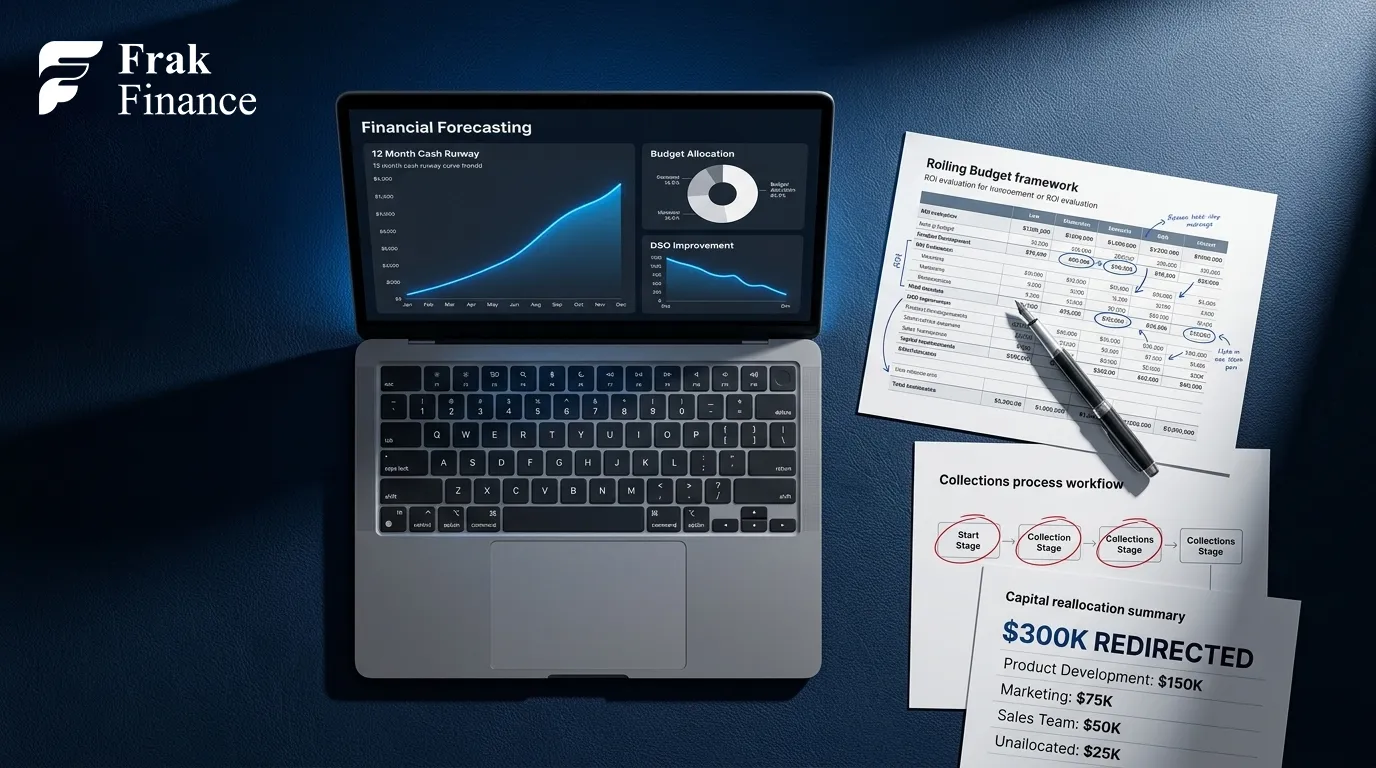
We built a rolling 12-month financial forecast tied to the company’s actual growth targets. For the first time, leadership could see where the business was heading financially, not just where it had been.
Step 2
Receivables were going out and sitting there. We tightened up the collections workflow, improved payment tracking, and got money moving faster. Days Sales Outstanding dropped by around 20%.
Step 3
Every major expense was run through an ROI evaluation. We identified what was actually generating returns and what wasn’t, then reallocated around $300K toward the initiatives that made more sense.
Step 4
We set up clear financial dashboards and reporting so leadership always knew their cash position, their runway, and what different scenarios looked like going forward.
A few months in, the numbers started moving in the right direction. Leadership could see their cash position 12 months out for the first time. Collections were running smoother, spending had a framework behind it, and the forecast was something they could actually trust and act on. Finance stopped being the thing slowing them down and started being the thing driving them forward.
Of customers recently chose a financial product from a provider other than their main bank.
Of revenues at risk between now and 2025 if card-issuing banks are slow to invest in next-gen payment options.
The share of US banks’ working hours which could be impacted by technologies like generative AI.
The cash flow improved fast. But the bigger change was how the business started operating day to day. With a proper financial system in place, decisions that used to feel like guesswork became straightforward calls backed by actual data.
At $2M in revenue, the real risk was making big decisions with no financial visibility.
The money was being earned. It just wasn't landing on time. DSO dropped 20% by fixing that.
$300K was already in the business. It just needed a proper framework to go where it mattered.
Smarter Spend, Not More Revenue $300K was already in the business. It just needed a proper framework to go where it mattered.
Technology (SaaS / Software Startup)
~$2M Annual Revenue
Not specified
Scaling
A multi-location entertainment venue with $14M in revenue had no monthly close, no consolidated reporting, and no visibility across sites. In months, they rebuilt the…

A medical device distributor moving $15–20M in gross sales had no QuickBooks file, no chart of accounts, and a founder running payroll through email. Here's…

A boutique consulting firm with a full pipeline kept hitting recurring cash flow gaps. Client-level profitability had never been tracked, pricing ran on instinct. One…

An $8M e-commerce business prepping for sale had inconsistent financials, undocumented EBITDA, and 40% revenue concentration in one client. 18 months later: diversified revenue, clean…

A seasonal retailer made money in-season and bled it back out the rest of the year. Inventory timing, vendor terms, and cash reserves were never…

A B2B SaaS company with $750K ARR signed a $4.5M LOI at a 6x multiple. Then the buyer's QoE failed. Recurring and one-time revenue were…
The cash flow improved fast. But the bigger change was how the business started operating day to day.
Finance and accounting leadership for privately held businesses at every stage. Ready to see what the right financial partner changes? Get in touch with Frak Finance today.