
Frak Finance

Consulting Firm Cuts Cash Flow Gaps in Half With KPIs

The firm had no profitability tracking and recurring cash flow gaps so we built the KPI system that changed how they operated.

Table of Contents

Table of Contents

The Situation

A Full Pipeline With No Profitability Tracking Behind It

The firm was winning clients, delivering work, and keeping the team busy. On the surface, things looked fine. But nobody could actually tell you which engagements were profitable, whether billable rates were covering the real cost of delivery, or why cash felt tight some months despite a full pipeline.

Every major call came down to what the founder thought was right. That instinct had gotten them this far. But the business had grown past the point where gut feel alone could replace actual performance data.

The Challenge

Revenue Coming In But No Margin, KPI or Cash Flow System Behind It

The firm had enough revenue coming in to look like a healthy business. But underneath that, there was no real picture of what was actually profitable. Some client engagements were consuming more billable hours and overhead than the retainer or project fee could justify. Service pricing had never been tested against actual cost of delivery. And every few months, cash got tight in a way that felt unpredictable but was entirely avoidable with structured cash flow planning.

The problem was not the business model. It was the complete absence of a financial management layer to run it with any precision.

Key Risk Factors

Our Approach

Built the Performance Tracking Layer From Scratch

We did not just review the numbers. We built the entire performance monitoring layer the business was missing, then used it to identify where profitability was leaking and where decisions needed to change.

1

Step 1

Set Up the Board Cadence

Locked meeting dates upfront, set a pre-read process one week before every meeting, and defined who owned what across the CEO, CFO, and board chair. Meetings had agendas, minutes, and action-item tracking so nothing fell through the cracks between sessions.

2

Step 2

Put Structure Around the Close and KPIs

Set a weekly leadership meeting rhythm, defined the month-end close window with a hard target of the 15th and no later than the 21st, and built KPI dashboards with named owners across sales, marketing, and finance.

3

Step 3

Built the 13-Week Cash Flow Model

Modeled weekly inflow targets against operating outflows of roughly $197K per week excluding rent and $250K including rent. Rent scenarios, funding needs, and runway were visible in one place and updated on a consistent basis.

4

Step 4

Tied Everything to a Budget and Growth Plan

Pressure-tested unit-level labor costs, revenue targets, and cash break-even assumptions at the location level. Set the FY2026 budget deadline at January 31 with year-end financials due February 15 and assigned clear ownership across the leadership team.

1

Step 1

Built a Core KPI Framework

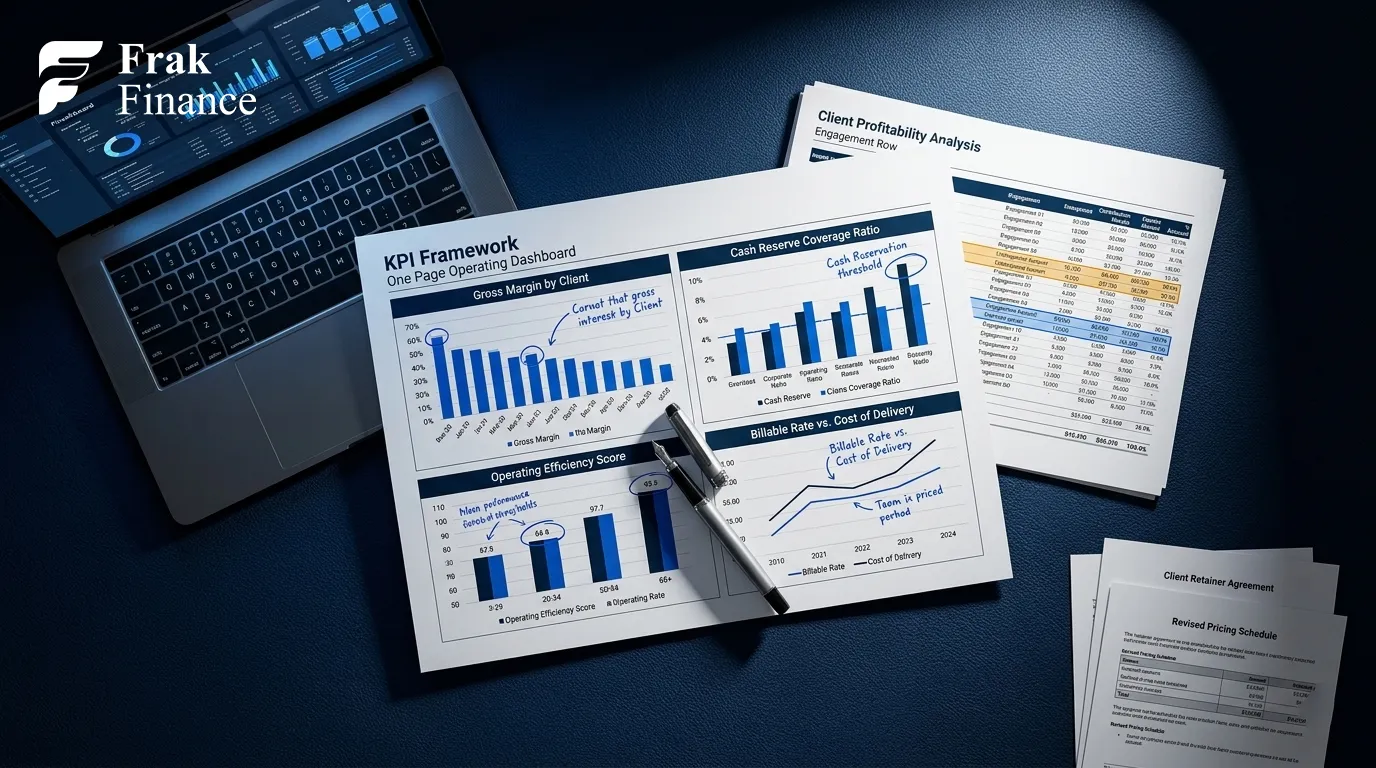
We established a structured system to track gross margin, client-level profitability, cash reserve coverage, and operating efficiency. For the first time, the business had a measurable operating language it could actually manage against.

2

Step 2

Developed a Financial Dashboard for Real-Time Visibility

We centralised all key financial and operational metrics into a single visibility framework. Leadership could now monitor business health continuously rather than waiting for month-end reports to tell them what had already gone wrong.

3

Step 3

Ran a Full Client Profitability Analysis

We broke down profitability at the individual client and service line level. This identified which engagements were underpriced relative to their cost of delivery and where margin was being left on the table.

4

Step 4

Restructured Pricing Around Contribution Margin

Using the profitability analysis, we supported targeted pricing adjustments across underperforming service segments. Every pricing decision was now backed by margin data rather than estimation.

The Turning Point

When Pricing Was Finally Tied to Contribution Margin

A few months in, leadership stopped making calls based on what they thought was happening and started making them based on what the numbers were actually showing. Client profitability was visible at the engagement level. Pricing was tied to contribution margin for the first time. And cash flow gaps that used to catch the business off guard were now forecasted and planned around before they hit.

Quantitative Results

Measurable Results From Getting the Financials Right

1 %

Demo Heading

Of customers recently chose a financial product from a provider other than their main bank.

1 B

Demo Heading

Of revenues at risk between now and 2025 if card-issuing banks are slow to invest in next-gen payment options.

1 %

Demo Heading

The share of US banks’ working hours which could be impacted by technologies like generative AI.

Qualitative Results

Operational Impact of Finally Having Financial Visibility

The percentage improvements were real but the bigger change was in how the business operated day to day. Leadership finally had a clear picture of which clients and engagements were worth the effort, pricing had a margin-based process behind it and cash flow was no longer something they dealt with after the fact. For a firm that had always run on founder instinct, having reliable financial visibility changed how confidently they could plan and grow.

Key outcomes

Testimonial.

Key Takeaways

Key Takeaways

Profitable But Could Not Prove It

No client-level tracking meant no way to know which engagements were actually driving margin

Pricing Was the Biggest Lever

Several engagements were underpriced once contribution margin was visible at service line level.

A Revenue Problem or a Planning Problem

The firm had enough revenue. What it lacked was a cash flow process to stay ahead of the gaps.

KPIs Changed How They Operated

Once margin and client profitability were tracked in real time, reactive decisions stopped.

Client Profile

Created by potrace 1.16, written by Peter Selinger 2001-2019

Industry

Boutique Consulting

Created by potrace 1.16, written by Peter Selinger 2001-2019

Company Size

~$18M annual revenue

Created by potrace 1.16, written by Peter Selinger 2001-2019

Timeline

3 years

Created by potrace 1.16, written by Peter Selinger 2001-2019

Stage

Scaling

Created by potrace 1.16, written by Peter Selinger 2001-2019

Engagement Type

Financial Dashboard Build

KPI System Design

Pricing & Profitability

Similar Cases We Have Resolved

Herrington Tax Consulting Informed Tax Strategies for Success

The cash flow improved fast. But the bigger change was how the business started operating day to day. 

x

Duis consequat libero ac tincidunt consectetur. Curabitur a magna sit amet orci mollis vehicula. Morbi at enim a ex mollis sodales ut eu elit. Quisque egestas.

Address Business
2220 Plymouth Rd #302
Hopkins, Minnesota(MN), 55305
Contact With Us
Call Consulting: (234) 109-6666
Call Cooperate: 234) 244-8888
Working Time
Mon - Sat: 8.00am - 18.00pm
Holiday : Closed